The original bet

Big and Small in a Casino — Sic Bo and the Older Version

Play Big Small

Long before any app existed, big and small were the two most popular bets on a sic bo table. The wager is the same idea with better documentation: three dice, a published house edge, and rules you can read before you sit down.

  • Dice 3
  • Big 11–17
  • Small 4–10
  • Typical edge ~2.8%

Sic bo is a three-dice game with a long history in Asian casinos and a familiar structure: bet on the total, the table pays according to a fixed schedule. Big and small are its two simplest wagers, and they exist for the same reason the app version does — an even-money bet is the easiest thing in any casino to understand and the easiest to keep playing.

The connection is worth knowing because it puts the app format in context. Nothing about timed rounds on a phone is new; the innovation is speed and access, not the wager.

Table rules

How Big and Small Work on a Sic Bo Table

Four rules, published on the layout, identical in every regulated house.

  • 01

    Three dice are rolled

    Totals run from 3 to 18. The bet is on where that total lands rather than on any individual die, which is what makes it an even-money proposition rather than a long shot.

  • 02

    Small is 4 to 10, big is 11 to 17

    Each covers a similar share of outcomes. Both pay even money — one to one — which is more generous per win than the app format's typical multiplier.

  • 03

    Any triple loses both

    Three of a kind — 1-1-1 through 6-6-6 — voids big and small alike. That single exception is the entire house edge on the bet, and it is printed on the table rather than embedded in a multiplier.

  • 04

    The edge is documented

    Around 2.8 percent in standard rules, published and verifiable. You can look it up before playing rather than deriving it from a payout figure the interface may or may not display.

Head to head

The Table Version Against the App Version

Same idea, two very different products around it.

Table

Sic bo big and small

  • Pays even money, with a documented ~2.8% edge
  • Rules printed on the layout and regulated where the venue is licensed
  • Physical dice you can watch being rolled
  • Slower, requires a venue, higher minimum stakes
VS
App

Timed big small rounds

  • Pays under double, with the edge inside the multiplier
  • Rules and payouts vary by build, sometimes unpublished
  • A server-generated number you cannot observe
  • Instant, tiny minimum stakes, available anywhere
Why the difference matters

Speed Is the Real Variable

Two products with similar edges can cost wildly different amounts per hour.

~2.8%house edge on the table bet
~5%typical edge inside an app multiplier
~40sic bo rolls in an hour at a busy table
60app rounds in an hour on a one-minute timer

Edge times volume is the whole story

A larger edge applied more often, at stakes small enough to feel harmless, is what makes the app format expensive relative to a table bet that looks similar on paper.

Practical

Three Things the Table Version Teaches

Useful even if you never sit at one.

A published edge is a feature

Regulated tables state their maths. An app that does not publish the payout on a winning call is withholding information that is trivially cheap to provide, and that omission is itself a data point.

Even money is the benchmark

The table pays one to one on this bet. When an app pays 1.95, the difference between those two numbers is what you are being charged for the convenience, and it is worth seeing it in those terms.

The exception clause matters

On a table, the triple rule is the edge and it is visible. In an app, the edge is folded into a multiplier where nobody has to look at it. Same mechanism, very different transparency.

Why the Casino Version Is Worth Knowing About

Not as a recommendation to play it — it is still a house-edge bet in a venue designed to keep you there. It is worth knowing because it provides a reference point. When you can see that essentially the same wager has been offered for decades at even money with a published edge, an app paying under double with an unstated one becomes easier to evaluate honestly.

It also disposes of a common claim in the app category: that this format is a new kind of game requiring new kinds of analysis. It is not new, and the analysis that applies to it is the same arithmetic that has applied to even-money casino bets for a very long time.

Live Dealer Versions in Apps

Some platforms stream a physical sic bo table and let you bet on it remotely, which sits between the two products described here. The dice are real and observable, the rules are the table's, and the pace is set by a human dealer rather than a countdown. That transparency is genuinely better than a generated number — with the caveat that everything about deposits, withdrawals and the operator's reliability still applies exactly as it does elsewhere.

For the app format and its arithmetic, see the big small game guide. For how the same round gets sold under colour-based labels, read the colour trading page.
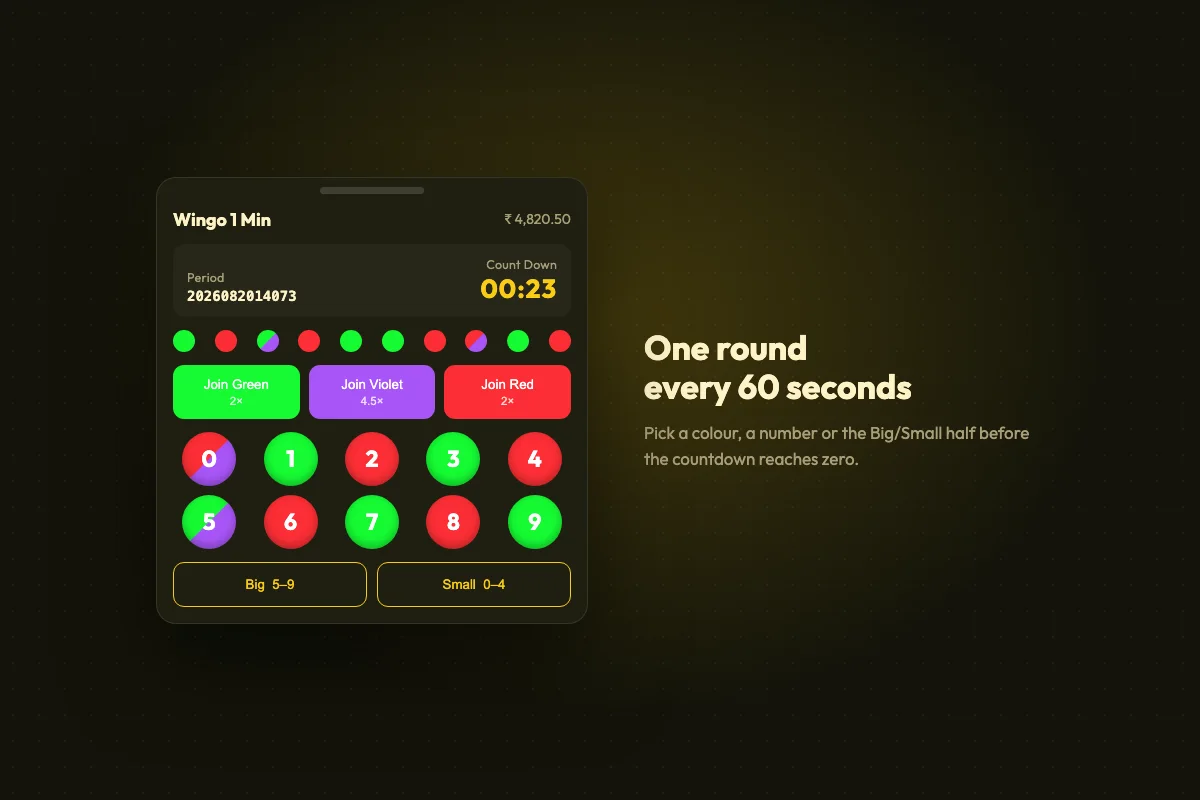
Colour prediction round board with a sixty second countdown, green, violet and red bet buttons and number balls zero to nine
FAQ

Casino Version FAQ

Five questions about the table bet and how it relates to the app format.

Same idea, different implementation. Sic bo uses three dice and pays even money with a documented edge; the app uses a generated number and pays under double with the edge inside the multiplier. The wager — high half or low half — is identical in spirit.

The table bet, on both counts: a smaller published edge and a slower pace. What the app offers instead is availability and tiny minimum stakes, which is a genuine convenience with a measurable price attached.

Because that exception is the house edge. Without it the bet would be exactly even and the casino would make nothing. It is an unusually honest arrangement: the edge is one printed rule rather than a number folded into a payout.

Many do, including live-dealer tables streamed from a real venue. Those keep the table's rules and pace, which makes them more transparent than a generated round — while every question about the operator's reliability still applies unchanged.

Only bet selection. Big and small carry the smallest edge on a sic bo layout, and the exotic bets carry much larger ones. Choosing the simple bet is the entire strategy, and no betting pattern improves it further.

Because they can. There is no published standard for the format, no regulator setting the payout, and the interface rarely invites comparison. Where a table competes with other tables on printed rules, an app competes on artwork and bonuses.

This website is for informational purposes only and is not a gambling operator: we do not accept bets or payments. 18+. Gambling involves risk and may lead to addiction — please gamble responsibly. Information (bonuses/terms/licenses) may change: check current rules on the operator’s website. We are not responsible for decisions and financial losses related to the use of third-party services.