Money rounds

Big Small Game Money — What It Costs and How Withdrawals Work

Play Big Small

Nothing about the rounds changes when the stakes are real. What changes is the arithmetic of your evening, and the fact that a second party now decides whether your balance ever leaves their platform.

  • Edge per stake ~5%
  • Rounds per hour up to 60
  • Withdrawal decided by the operator
  • Test deposit the minimum

The honest way to price this format is per hour, not per round. A one-minute timer produces sixty rounds; at fifty rupees a round that is three thousand rupees of turnover, and the operator's edge applies to all of it regardless of how the individual calls went.

Five percent of three thousand is a hundred and fifty rupees an hour, before variance. That is the expected cost of the entertainment — not the worst case, not the result of playing badly, just the price of sitting at the table. Any evening that ends better than that was luck, and any evening that ends far worse was variance rather than a mistake.

Turnover

What Different Round Types Actually Cost

Same stake, same edge, different exposure — because exposure is a function of speed.

₹3,000hourly turnover at ₹50 on 1-minute rounds
₹1,000the same stake on 3-minute rounds
₹600the same stake on 5-minute rounds
5xdifference in hourly cost, from one choice

The most useful setting in the game

Round length changes your hourly cost by a factor of five and nothing else about the experience. It is the single most effective adjustment available, and almost nobody makes it because slower rounds feel less like playing.

Stake sizing

Choosing a Number You Can Actually Lose

Four tests, in order. A stake failing any of them is the wrong stake whatever the balance says.

  • 01

    The five-in-a-row test

    Would losing this amount five times consecutively change your evening? Five losses in a row happens roughly once every thirty-two sequences — which at sixty rounds an hour is about twice an hour.

  • 02

    The hourly test

    Multiply the stake by the rounds you will play. That total, not the per-round figure, is the price of the session — and it is the number worth being comfortable with before starting.

  • 03

    The flat-stake rule

    One amount for the whole session, no adjustment after a win or a loss. Every progression system increases exposure at the worst possible moment, and none of them reduce the edge.

  • 04

    The written-down rule

    Stake, round count and stop-loss recorded somewhere you will see them. Numbers held in your head get renegotiated silently; numbers in a note do not.

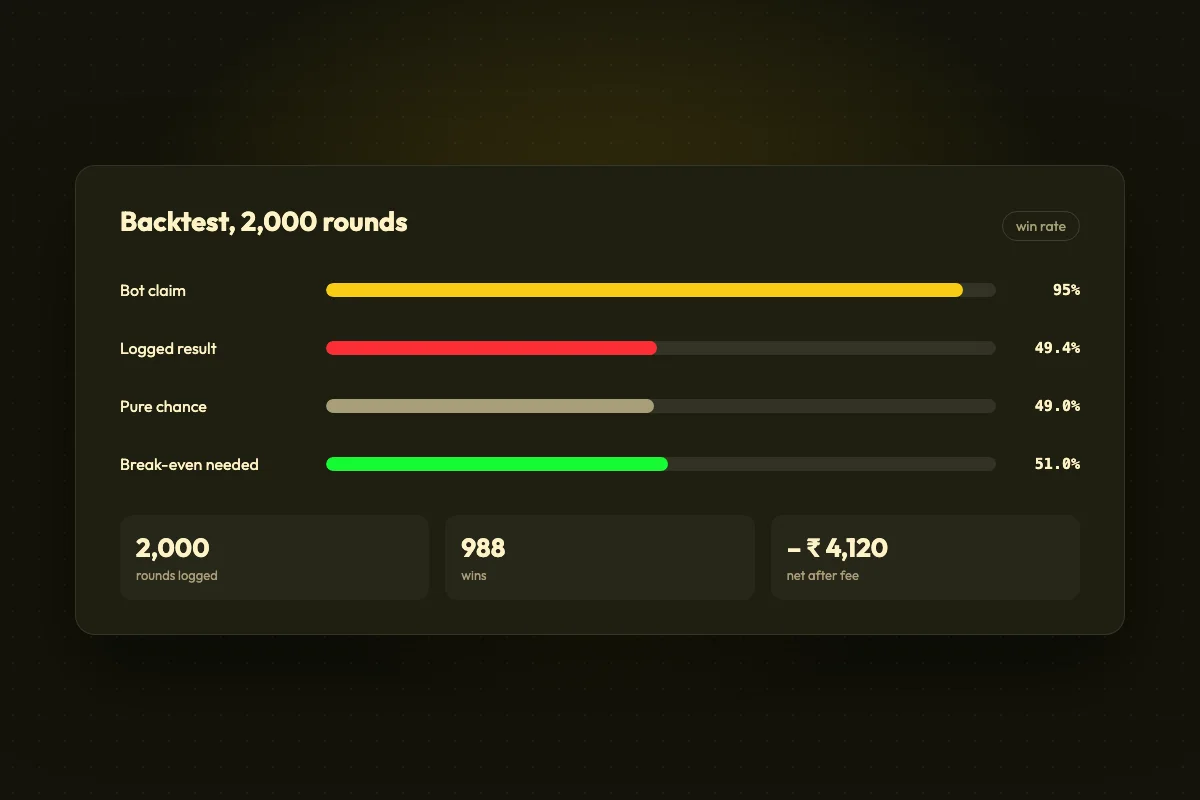
Backtest panel comparing a bot’s claimed ninety-five per cent win rate with the forty-nine per cent logged over two thousand rounds
The round is the easy part. Getting money back out is the part to test.
Before anything larger

Test the Withdrawal Before You Trust It

Deposit the minimum the operator allows, play a handful of rounds, and withdraw. That single experiment tells you more about a platform than every review of it, because it exercises the one process that determines whether your balance is real to you.

Do it before the amounts matter. An operator that pays a small withdrawal smoothly has demonstrated something; one that adds requirements at that stage has also demonstrated something, and you have learned it while the stake was trivial.

Problem and cause

Three Reasons a Withdrawal Stalls

In order of likelihood. The first two are ordinary and the third is the one people miss.

Verification is incomplete

Identity checks at withdrawal are standard and appropriate — an operator paying out without ever confirming who you are would be a larger warning, not a smaller one. Complete the verification when you open the account rather than when you want the money.

The balance is under the minimum

Withdrawal minimums are frequently higher than a typical win, which quietly keeps balances inside the platform. Read that figure before depositing, because a minimum set above what you intend to hold is a design decision rather than an accident.

A bonus locked the account

Accepting a promotion often attaches wagering conditions to your own deposit as well as the bonus. Until the turnover requirement is met, nothing leaves — and forfeiting the bonus to release your funds is not always offered once you have started.

When it is none of those three

If verification is done, the balance clears the minimum and no bonus is attached, and the withdrawal still does not move, stop depositing immediately. Escalate through whatever channel the operator publishes, and treat the balance as at risk rather than as a savings account.

The Earning Framing Is the Expensive Part

Search terms in this category are full of earning language — paisa kamane wala, paise jitne wala, money withdrawal apps. That framing converts a short, high-variance entertainment product into something resembling work with a payout, and it is the single most reliable predictor of a bad outcome. The edge does not care about intentions: over enough rounds, the expected result of playing is a loss, and every hour spent trying to make it into income is an hour of turnover.

The alternative framing costs nothing. Decide what an evening of this is worth to you, treat that amount as spent the moment you deposit it, and stop at the round count you chose. Anything that comes back is a refund on entertainment rather than a return on investment.

Signs a Session Has Stopped Being Recreational

Raising the stake after a loss. Playing past the number you set because the last round was close. Depositing a second time in one session. Reopening the app to "get back" to a previous balance. Feeling relief rather than enjoyment when a round wins. None of these are moral failings — they are the predictable output of a well-designed variable-reward loop, and every one of them is a reason to close the app for the day rather than to look for a better system.

For the mechanics and the payout arithmetic behind all of this, see the big small game guide. If you want to keep playing the same rounds at no cost, the demo notes explain how practice mode works and what it can teach.
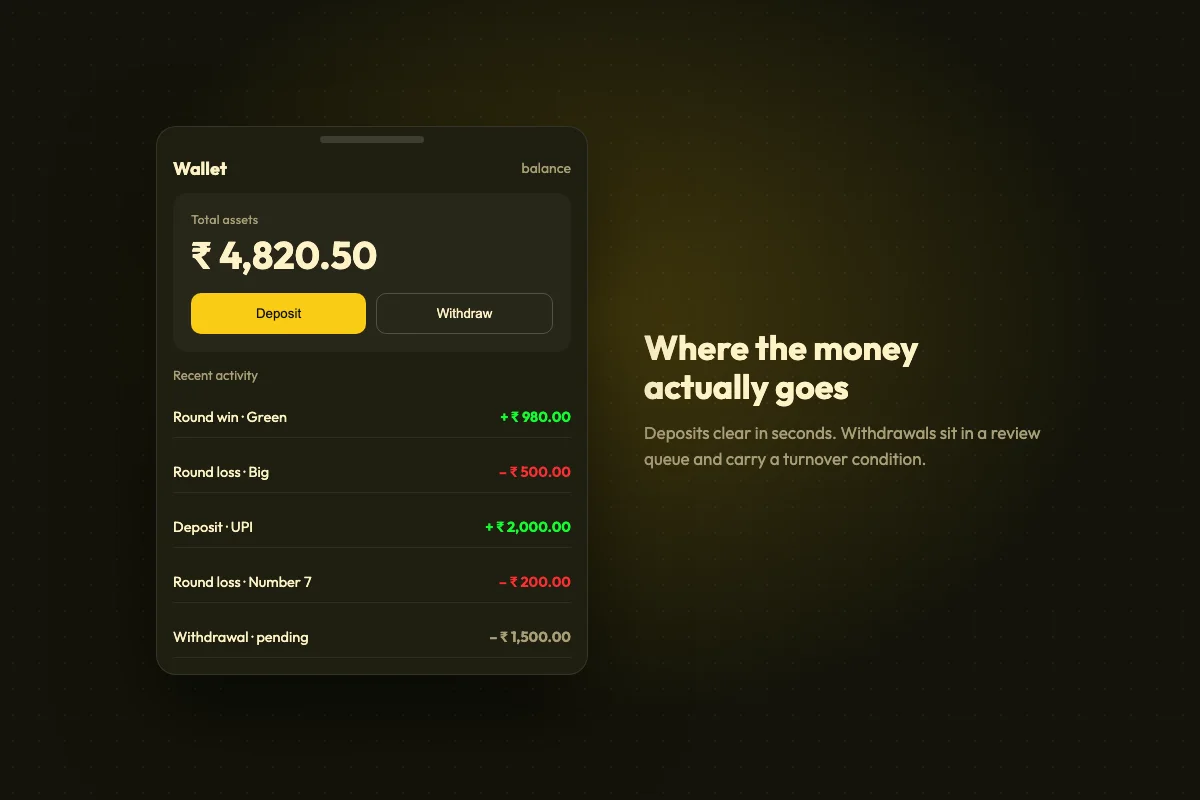
Wallet screen showing the balance, deposit and withdraw buttons and a list of recent round wins and losses
FAQ

Money and Withdrawal FAQ

Six questions about playing for real money and getting it back out.

Individual sessions can finish ahead. Across many rounds the operator's edge means the expected result is a loss, and no betting pattern changes that. Treating it as income is the most expensive misunderstanding available in this category.

No. The stake scales what you win and lose, not the probability of either. A larger stake shortens how long a fixed budget survives, which is the opposite of what most people intend when they raise it.

Small enough that five losses in a row changes nothing about your evening, and held flat for the whole session. Multiply it by your planned round count to see the real price — that total is the number to be comfortable with.

Usually incomplete verification, a balance below the withdrawal minimum, or an accepted bonus with wagering conditions attached. All three are readable in the terms before you deposit, which is the only useful time to read them.

Withdraw regularly instead. Operators in this category open and close on short timescales, and money inside a platform that stops resolving is generally not recoverable by any route available to a player.

The slowest one offered. It does not change the odds and it cuts your hourly turnover — and therefore your expected hourly cost — by up to five times. It is the most effective adjustment in the entire interface.

This website is for informational purposes only and is not a gambling operator: we do not accept bets or payments. 18+. Gambling involves risk and may lead to addiction — please gamble responsibly. Information (bonuses/terms/licenses) may change: check current rules on the operator’s website. We are not responsible for decisions and financial losses related to the use of third-party services.