Same round, two labels

Colour Trading and Big Small — One Mechanic, Two Names

Play Big Small

Colour prediction, colour trading and big small are not competing formats. They are bets placed on the same generated number, in the same round, on the same timer — and the word "trading" is the most consequential piece of marketing in the whole category.

  • Same round yes
  • Same generator yes
  • Colour payout often 2x / 4.5x
  • Resembles trading no

One number is generated per round. Big small asks which half it falls in. The colour bet asks which colour that number is mapped to. Both settle from the same draw, at the same moment, with the same server deciding.

Which means switching between them is not a change of strategy, a change of game or a change of odds in any meaningful sense — it is choosing a different way to bet on the same event. Any guide that treats colour prediction and big small as separate disciplines is padding.

Payout shapes

What Each Bet Actually Returns

Different multipliers, different hit rates, the same house edge underneath — which is the part nobody advertises.

  • 01

    Big or small

    Covers half the range and pays a little under double. The simplest bet in the format and the one whose maths is easiest to check for yourself.

  • 02

    The main colours

    Usually mapped so that each covers a similar share of outcomes, paying close to double. Functionally equivalent to the high-low bet with a different label on the button.

  • 03

    The rare colour

    Covers far fewer numbers and pays several times the stake. Lower hit rate, larger payout, and — in most builds — a slightly worse deal than the even-money bets once you work the arithmetic through.

  • 04

    The exact number

    One in ten, paying around nine times. The biggest headline multiplier in the interface and usually the largest edge, which is exactly why it is displayed so prominently.

Language

Why "Trading" Is the Dangerous Word

The vocabulary borrowed from finance changes how people behave, not what the product does.

What it implies

The trading framing

  • That analysis and charts improve results
  • That skill accumulates with practice
  • That a bad run can be researched away
  • That this is a form of investing
VS
What is true

The actual product

  • A random number generated after bets close
  • Independent rounds with no readable pattern
  • A fixed operator edge charged on every stake
  • No asset, no ownership, no underlying value

The practical harm

Trading language justifies studying, and studying justifies staying. Someone who believes they are analysing a market plays longer than someone who knows they are betting on a coin — and time at the table is what the edge converts into money.

Practical

Three Things to Check on a Colour Build

Same checks as anywhere else in this category, with one addition specific to the colour bets.

Compare the multipliers against the coverage

Count how many numbers each colour covers, then compare that share against what the bet pays. Where a bet covers three numbers in ten and pays four and a half times, the edge on it is larger than on the even-money options — and that is worth knowing before you chase the bigger number.

Ignore the chart tools entirely

Colour builds ship the most elaborate history panels in the category: streak counters, heat maps, trend arrows. All of it is a display of past independent events, and none of it carries information about the next round.

Treat the demo as a payout reference

Where a practice mode exists, record what each bet type pays. Those figures are the most portable thing you can carry between builds, and they are how an edited client gets caught.

Why the Two Names Persist Side by Side

Because they attract different people. "Colour prediction" sounds like a game and appeals to curiosity; "colour trading" sounds like finance and appeals to ambition; "big small" describes a bet and appeals to people who already know what they are doing. Same rounds, three audiences, and a marketing surface wide enough to reach all of them.

For a player, the practical consequence is that advice written under one label applies perfectly to the others. If you understand what a win pays and how many numbers your bet covers, you understand every version of this format regardless of what the buttons are coloured.

The One Genuine Difference

Bet variety. A colour build usually offers more ways to stake on the same draw — halves, colours, exact numbers, sometimes combinations — and more options mean more opportunities to pick a worse one. The simplest bet in the interface is almost always the one with the smallest edge, which is an unusual case of the boring choice also being the mathematically better one.

For the underlying round and its arithmetic, see the big small game guide. For why the charts and streak tools shipped with these builds cannot work, read the prediction and tricks page.
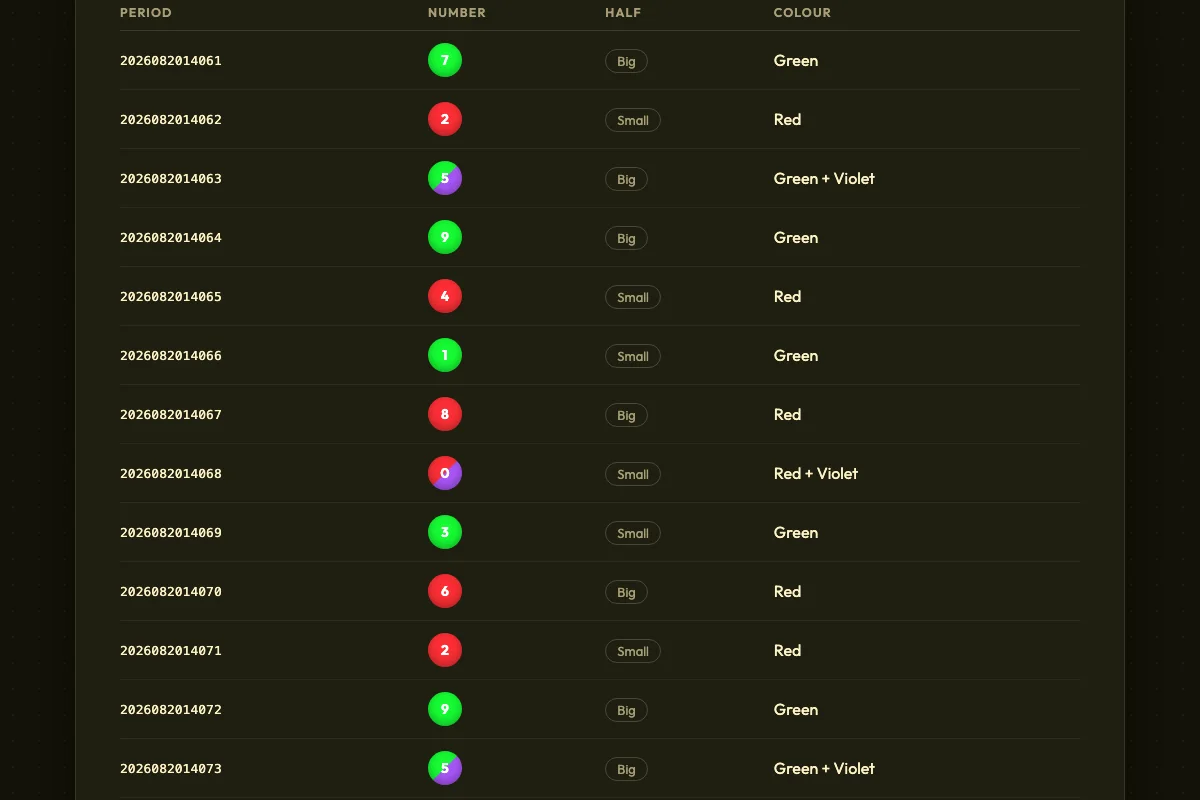
Round history table listing period numbers, the drawn ball, the Big or Small half and the winning colour
FAQ

Colour Trading FAQ

Five questions about how the colour bets relate to big small.

They are two bets on the same generated number in the same round. The colour bet maps numbers to colours; the big small bet splits the range in half. Same draw, same server, same timer — different buttons.

Usually the simple even-money ones — big, small, or a main colour. The high-multiplier bets on rare colours and exact numbers generally carry a larger edge, which is why they are displayed most prominently.

No. There is no asset, no ownership and no underlying value — only a random number and a payout table. The word borrows credibility from finance and encourages the belief that analysis helps, which is where the real damage happens.

Only as a record of what already happened. Rounds are independent, so no arrangement of history predicts the next result. Elaborate chart tools exist because they make the product feel analysable, and analysable products retain players longer.

Most builds allow it, and it is worth understanding what it does: two stakes on one draw, each with the house edge applied. Covering more outcomes does not reduce the edge, it increases the amount of money exposed to it per round.

More options mean more turnover and more chances to choose a bet with a larger edge. The simplest wager on the screen is usually the best one available, which is an unusual case of the least exciting choice also being the correct one.

This website is for informational purposes only and is not a gambling operator: we do not accept bets or payments. 18+. Gambling involves risk and may lead to addiction — please gamble responsibly. Information (bonuses/terms/licenses) may change: check current rules on the operator’s website. We are not responsible for decisions and financial losses related to the use of third-party services.