Link checks

Big Small Game Link — Judging One Before You Open It

Play Big Small

We publish no list of links, and a site that maintains one is doing you a disservice dressed as a favour. What is useful is a way to judge the link you already have — five checks, about thirty seconds, no technical knowledge required.

  • Mirror lists here none
  • Checks 5
  • Riskiest source chat forwards
  • Time needed <1 min

A link is not a product. It is an address, and addresses change hands. The mirror that behaves correctly today can serve a different build tomorrow without a single character of the address changing.

That is why a published list ages into a liability: readers treat it as an endorsement long after the entry has gone bad, and the sites that maintain such lists are frequently paid to add entries in the first place. A method that stays valid is worth more to you than a list that was accurate on the day it was written.

Method

Five Checks on Any Link

In this order. Most bad links fail one of the first two, which takes about ten seconds.

  • 01

    Read the address character by character

    Copies live on near-miss spellings: a doubled letter, an extra hyphen, a different ending after the dot. It remains the most effective trick on the internet because nobody reads an address they were already expecting to see.

  • 02

    Ask where it came from

    A link you found yourself is not the same object as one forwarded by somebody who was also forwarded it. By the third forward the chain has no origin at all, and provenance is the cheapest signal available to you.

  • 03

    Open it and see what it wants first

    A build that shows you rounds, rules and a payout figure before asking for anything is behaving normally. A registration wall in front of the first screen means the page's product is your contact details.

  • 04

    Check the payout against a build you trust

    The multiplier on a winning call is fixed and visible. If it differs from the reference figure you already have, the page is running an edited client no matter how convincing the artwork looks.

  • 05

    Refuse anything whose first action is a file

    Legitimate access starts with a page. A link that immediately hands you an install file has answered the question for you, and the answer does not improve if you keep reading.

Hidden destinations

Three Link Shapes That Remove Your Judgement

Each one takes away the ability to decide before you arrive.

The shortener

Tells you nothing about the destination. There are legitimate uses for short links, and "here is the game" is not one — the sender had a full address and chose to hide it.

The urgent link

"Working today only", "new link, old one banned", "join before it closes". Urgency exists to stop you checking, and an operator's real address does not expire this afternoon.

The referral tail

Not dangerous by itself, but it tells you the sender is paid for your arrival. Weigh their enthusiasm accordingly, particularly when it comes with promises about winnings.

About "latest link" searches

The phrase usually means a bookmark stopped working, not that a newer address exists. Access failures are far more often a regional block, a cached page or a network filter — and "latest link" is exactly the phrase copies target, because it identifies someone who has stopped checking.

Damage control

If the Link Turns Out to Be Fake

Three positions, in rising order of seriousness.

You only looked at the page

Nothing was installed and nothing was submitted. Close the tab, clear it from history, and do not go back for a second look — the second visit is where people register.

You registered before you noticed

An email address and probably a phone number are on a list now, and if you reused a password it is on that list too. Change that password everywhere else it appears, starting with email and banking, and treat the "your account is ready" messages that follow as hostile.

You installed what it offered

Uninstall it, revoke any SMS or accessibility permission you granted, change the passwords of anything you logged into afterwards, and turn the unknown-sources setting back off. Do the password step from a different device if the app had accessibility access.

Why One Game Has So Many Addresses

Partly for ordinary reasons: operators run regional domains, partners run tracking links, and a popular format accumulates mirrors the way a popular song accumulates uploads. Partly not. A simple interface, a large audience and informal distribution make this category unusually easy to copy, and the copies need addresses of their own to rank for the same searches.

The result is a search page where the genuine article and half a dozen imitations sit side by side, all using identical artwork and similar names. Appearance cannot separate them. Behaviour can: what the page asks for before it shows you anything, and what it pays on a winning call.

What We Would Do With an Unfamiliar Link

Open it in a browser rather than an app, look for the payout figure and the rules before touching a form, compare that figure against a build we already know, and leave if any of the three is missing. If the page passes and we intend to deposit, test the withdrawal path with the smallest amount the operator allows before anything larger goes in. None of that is sophisticated, and all of it is faster than recovering from the alternative.

For the mechanics behind the rounds themselves, start with the big small game guide. If the link has already taken you to a sign-up screen, the login and account notes set out what a genuine registration asks for and what it never asks for.
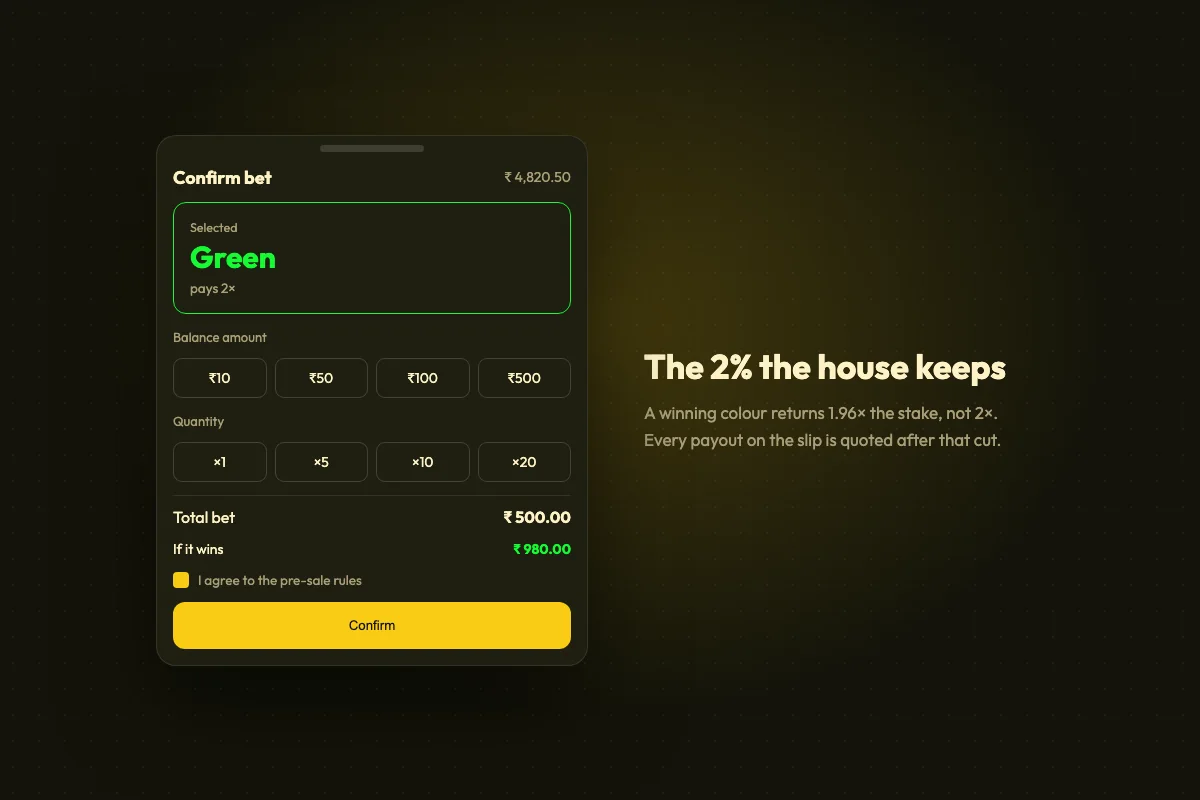
Bet confirmation screen with Green selected, stake and quantity chips and the payout left after the two per cent fee
FAQ

Link FAQ

Five questions about finding and judging an address for this format.

Because a published address becomes an endorsement that outlives its accuracy. Mirrors change hands, regional domains are retired, and pages get sold. A method you can apply yourself stays useful; a list quietly stops being true.

Treat it as unverified by default. Forwarded links have no traceable origin, and that chain is precisely how repackaged builds spread. Run the five checks before entering anything, and never install a file the link offers.

No. Rules, round types and the payout on a win should all be readable before any form appears. A registration wall in front of everything means the page is collecting details and the game is the bait.

Usually nothing. It is what people search when a bookmark stops loading, and the cause is far more often a regional block or a cached page than a retired address. Copies target the phrase precisely because it signals urgency without checking.

Ask the sender for the full address. If they cannot produce one, that answers the question. Expander tools exist, but the simpler principle holds: a link that needed hiding is one you can decline at no cost.

No. Domains are cheap and any word can appear in one, including "official", "real" and the operator's own brand name. What a copy cannot fake as easily is the payout figure matching a build you already verified.

This website is for informational purposes only and is not a gambling operator: we do not accept bets or payments. 18+. Gambling involves risk and may lead to addiction — please gamble responsibly. Information (bonuses/terms/licenses) may change: check current rules on the operator’s website. We are not responsible for decisions and financial losses related to the use of third-party services.