Format comparison

Big Small, Lottery and Number Games — Three Different Shapes

Play Big Small

All three get filed together in search results and they behave nothing alike. The differences are not cosmetic: hit rate, payout size and how a bankroll drains are completely different, and mixing them up produces badly wrong expectations.

  • Big small hit rate ~50%
  • Number pick ~10%
  • Lottery far lower
  • Edge in all three yes

Every one of these is a bet with an operator edge. What separates them is the shape of the outcome: how often you win, how much a win returns, and therefore how a session feels while your money disappears at broadly similar rates.

That shape matters more than most players expect, because it determines which psychological trap each format sets. Frequent small wins encourage long sessions. Rare large ones encourage repeated small purchases. Neither pattern is safer, and knowing which one you are in is genuinely useful.

Shapes

Three Formats, Three Outcome Curves

Same category in a search result, different products entirely.

  • 01

    Big small — the even-money bet

    Roughly half the rounds win, each paying a little under double. Sessions feel active and balanced, and the losses arrive gradually — which is precisely why people stay long enough for the edge to accumulate.

  • 02

    Number pick — one in ten

    Choosing an exact number wins about a tenth of the time and pays roughly nine times. Sessions are long dry stretches punctuated by a payout that usually fails to cover them, and the edge here is typically larger than on the even-money bet.

  • 03

    Lottery — rare and large

    Odds measured in tens of thousands or worse, prizes measured in multiples of a lifetime's stake. A structurally different product: buying a small chance at a large change rather than playing rounds.

  • 04

    What all three share

    An operator's cut taken from the pool. The percentage varies — often it is largest in the lottery — and no format on this list returns more than it takes over time.

Two traps

How Each Shape Gets You

Frequent-win and rare-win products fail players in opposite ways.

Frequent wins

The big small trap

  • Winning half the time feels like competence
  • Short rounds erase the sense of time passing
  • The edge appears only in the total, never in a single round
  • Sessions end when you stop, not when the game stops
VS
Rare wins

The lottery trap

  • Each purchase is small enough to seem costless
  • The prize is vivid, the odds are abstract
  • Repetition accumulates without ever feeling like a session
  • Near misses feel like progress and are not
Identification

Working Out Which One You Are Looking At

Three questions settle it in seconds.

How often does it resolve?

A countdown of minutes means the round-based format. A daily or weekly draw means a lottery, and the two should not be evaluated with the same instincts.

What does a win pay?

Just under double means an even-money bet. Nine times means a one-in-ten pick. Thousands of times means a lottery, whatever the interface calls itself.

How many outcomes are covered?

Count them. Half the range, one number in ten, or one combination in tens of thousands — that count and the payout together tell you the edge more honestly than any description.

Why Apps Bundle All Three

Because different shapes suit different moods, and a platform holding all of them keeps a player when one stops appealing. A build offering big small, exact-number bets and a daily draw is not offering three games so much as three ways to keep the same person betting through the evening — and the switch usually happens after a losing run, in the direction of the larger payout.

That switch is worth noticing when you make it. Moving from an even-money bet to a nine-times bet after losses is not a change of strategy; it is an increase in exposure at the moment least likely to be a good idea, and the exact-number bet usually carries the larger edge of the two.

Which One to Prefer, If Any

Of the three, the simple even-money bet usually has the smallest edge and the most transparent maths — you can verify what it pays in a minute. That does not make it a good way to spend money; it makes it the least bad of a set, and the honest recommendation is still to decide an amount in advance and treat it as spent.

For the mechanics of the round-based format, see the big small game guide. For how the same round is sold with colour labels and extra bet types, read the colour trading page.
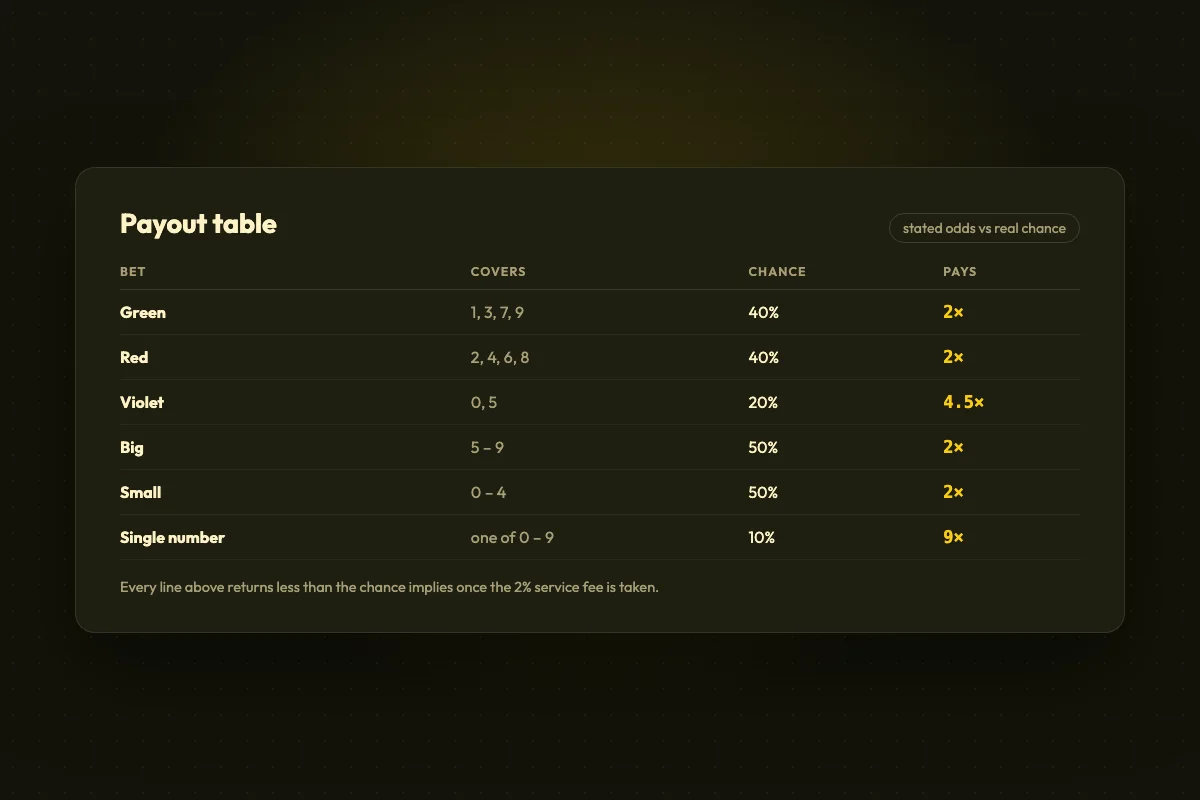
Payout table setting each bet type’s real chance against the multiplier it actually pays
FAQ

Lottery and Numbers FAQ

Five questions about how these formats differ.

The phrase gets used loosely for round-based betting apps that also run draws. The two things behave differently: rounds resolve every few minutes at even money, draws resolve rarely for large prizes. Check the round timer and the payout to see which you are in.

The even-money bet, in almost every build. It covers half the outcomes and typically carries a smaller edge than the exact-number bet, which pays around nine times for a one-in-ten chance — a gap that favours the operator.

There is nothing to transfer. Lottery systems mostly concern number selection, and in an even-money bet there are only two options, both equivalent. What carries across is the arithmetic — an edge applied to turnover — and it applies to both.

Because a large number is a better advertisement than a good deal, and because those bets usually carry the larger edge. The most prominent option on the screen is rarely the most favourable one available.

Small stakes played frequently produce large turnover, and turnover is what the edge is charged on. A ten-rupee bet sixty times an hour is six hundred rupees through the game — the size of the individual bet is not the number that matters.

By the clock and the payout. Minutes and a near-double return means a round; hours or days and a large multiple means a draw. Interfaces blur the distinction deliberately, and the two deserve very different levels of caution.

This website is for informational purposes only and is not a gambling operator: we do not accept bets or payments. 18+. Gambling involves risk and may lead to addiction — please gamble responsibly. Information (bonuses/terms/licenses) may change: check current rules on the operator’s website. We are not responsible for decisions and financial losses related to the use of third-party services.