Behind the build

Big Small Game Development — What Building One Involves

Play Big Small

Searches for big small game development come from two directions: people curious how the rounds are produced, and people considering building one. Both deserve an honest answer, and the honest answer starts with the part nobody advertises — the legal position comes before the code.

  • Hard part not the game
  • Result generation server-side
  • Regulation state by state
  • Real cost centre payments
Architecture

The Parts a Round-Based Game Needs

Four components. Only the first is visible to players, and it is by far the least demanding.

  • 01

    The client

    A web page or an app that draws a timer, takes a bet and displays a result. This is the part people imagine when they think about building a game, and it is a week of work for a competent developer.

  • 02

    The round service

    Runs the clock, accepts bets until the lock, generates the result and settles. It has to be authoritative — the client can never be trusted with anything — and it has to behave identically for every connected player simultaneously.

  • 03

    The ledger

    Balances, deposits, withdrawals, an audit trail for every movement. This is real financial software: idempotent operations, reconciliation, and a design that assumes anything can fail halfway through.

  • 04

    Compliance and payments

    Identity verification, transaction monitoring, payment provider relationships and reporting. Almost always the largest and slowest part of the project, and the one that decides whether the platform can operate at all.

Payout design

Where the Edge Comes From

One number decides the entire economics of the product, and it is not hidden — it is simply not advertised.

50%of outcomes covered by an even-money call
2.00xwhat a fair bet would pay
1.95xwhat these builds typically pay
~2.5%expected operator return on turnover

Why round length is a business decision

Revenue is edge multiplied by turnover, and turnover is a function of round speed. Shortening rounds from five minutes to one multiplies hourly turnover by five without changing a single line of the payout table — which is why so many builds default to the fastest option.

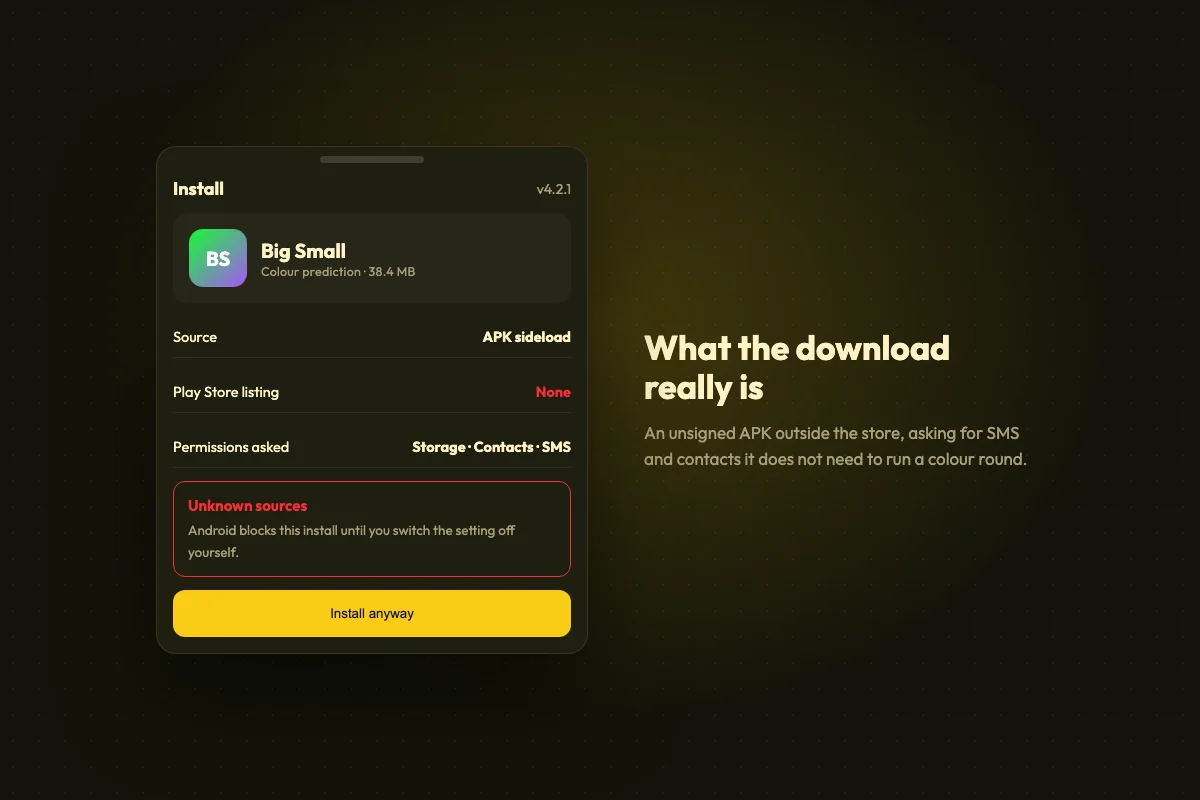
Sideloaded app install screen with no store listing and requests for storage, contacts and SMS permissions
A published seed is worth more than any assurance in a footer.
Provable fairness

The Feature Most Builds Skip

Commit-and-reveal fairness is well understood and not difficult: publish a hash of the seed before the round, reveal the seed afterwards, let anybody verify that the result matches. It converts "trust us" into something a player can check independently.

Very few builds in this category implement it, which is informative in itself. The engineering cost is modest; the reason it is absent is that most operators are not competing on verifiability. A build that does implement it has spent effort on the one feature that cannot be faked with artwork.

Reality check

Three Things That Sink These Projects

None of them are the game loop.

Payments and settlement

Getting money in is difficult; getting it out reliably, at volume, with chargebacks and failed transfers and reconciliation, is where most of the engineering effort actually goes. Every complaint players have about withdrawals is a symptom of this layer being underbuilt.

Abuse and multi-accounting

Bonus abuse, referral farming, coordinated betting and automated clients arrive immediately at any scale worth having. Detecting them without punishing ordinary players is a permanent operational cost rather than a feature you finish.

The regulatory position

Rules differ by state, change over time and apply to marketing and payments as well as to the game. Projects in this space fail on compliance far more often than on code, and the failure usually arrives after money is already involved.

Why This Page Exists

Because "big small game development" is a real search with two very different audiences, and both are better served by an accurate description than by a sales page. Players who understand that results are generated server-side stop believing in predictor apps. Developers who understand that payments and compliance dominate the work stop underestimating the project by an order of magnitude.

It is also worth stating plainly that the technical simplicity of the game loop is exactly why this category is full of clones. When the visible product is a week of work, the differentiator becomes distribution and marketing — and that is precisely the environment in which repackaged builds with trimmed payouts thrive.

If You Are Evaluating a Development Quote

Ask what happens when the round service restarts mid-round, how balances are reconciled after a failed payment, whether the result generation is verifiable by a player, and who is responsible for compliance in each state you intend to operate. A quote that focuses on screens and animations and treats those four questions as details is quoting for the easy week and omitting the hard year.

For how the finished product behaves from a player's side, see the big small game guide. For why the server-side design makes every predictor and mod claim impossible, read the hack claims page.
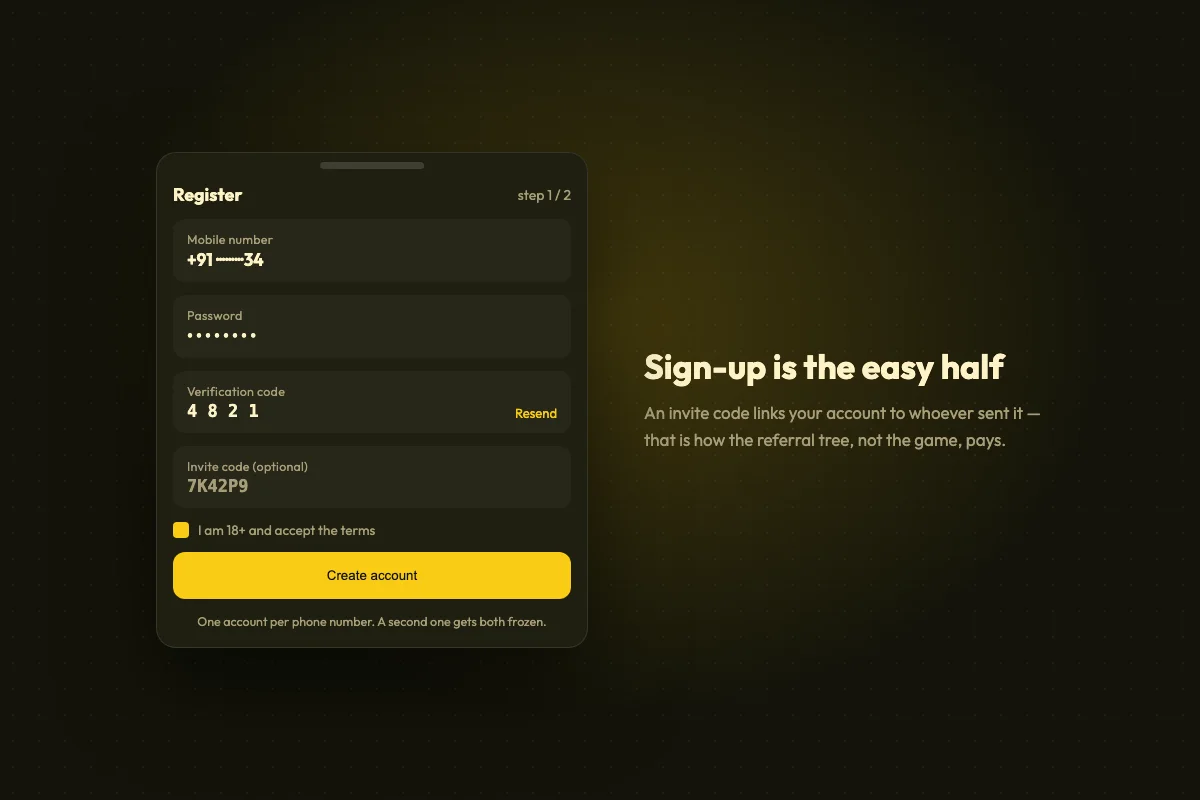
Registration screen with mobile number, password, verification code and invite code fields
FAQ

Development FAQ

Five questions from both sides of the search.

By a random number generator on the operator's servers, after betting closes for that round. The client never participates — it sends a bet and receives an outcome, which is why nothing installed on a phone can influence or predict it.

No, and that is the point. A timer, a generator and a payout table is a small piece of software. The difficulty lives in the ledger, the payments layer, abuse handling and compliance — none of which the player ever sees.

A scheme where the operator publishes a hash of the round's seed before betting and reveals the seed afterwards, so anyone can verify the result was not chosen after the fact. It is well understood, inexpensive, and absent from most builds in this category.

That depends on the state and on specifics no web page can assess. Real-money gaming is regulated at state level and the position changes. Anyone seriously considering it needs specialist legal advice before writing code, not after launching.

Because white-label platforms and outright clones are both cheap. When the visible product takes a week to produce, competition moves to distribution — which is also why edited copies with trimmed payouts spread so easily in this category.

In one specific way: it settles the prediction question permanently. Once you know the result is produced server-side after bets close, every trick, chart and mod file becomes obviously impossible rather than merely unproven.

This website is for informational purposes only and is not a gambling operator: we do not accept bets or payments. 18+. Gambling involves risk and may lead to addiction — please gamble responsibly. Information (bonuses/terms/licenses) may change: check current rules on the operator’s website. We are not responsible for decisions and financial losses related to the use of third-party services.